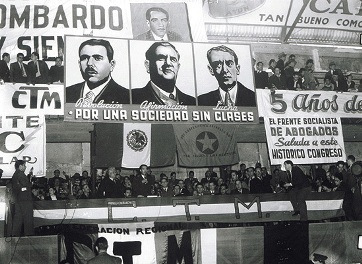
I wrote an article many years ago and it sat in the queue at the Journal of Cold War Studies for six years. Now it’s available, I guess, but I am not left feeling that this is a good system for disseminating knowledge. Although I would periodically update the article, I’m only nominally the same person that I was six years ago. (From a “ship of Theseus” perspective, my understanding is that the human body replaces every cell in it approximately every seven years, so that is almost literally true.) Anyway, the article assesses some debates about post-war union confederations from the perspective of Latin America. I looked at the same sources that document the infamous CIA money to European labor unions and found that it didn’t arrive in Latin America until later.\
This article examines the origins of the American Federation of Labor’s efforts at anti-Communist labor diplomacy in Latin America, and the divisions of a unified continental labor federation into pro- and anti-Communist groups in the early years of the Cold War. It describes the pre-WWII precedents for labor internationalism in the Western Hemisphere, and how wartime conditions created unusual potential for unity in the Confederación de Trabajadores de América Latina. But it also shows that anti-Communist activists—in the AFL and within the CTAL itself—sought an alliance to create their own federation, which eventually became the Organización Regional Interamericana de Trabjadores. The article describes the ways that the U.S. government did and did not support these efforts—showing that, in contrast with Europe, CIA funding to support the AFL’s efforts was miniscule in Latin America in this period. It argues that accounts of Cold War labor division that look only to Europe and focus on the Marshall Plan or CIA dollars need to account for the fact that such divisions took place elsewhere too, where those conditions were not present. It is unity, not division, that needs explaining. Nevertheless, the article concludes by noting that many of the “free” trade unions became pillars of authoritarian systems, and were more anti-Communist than they were “free.”



 patrick iber
Leave a comment