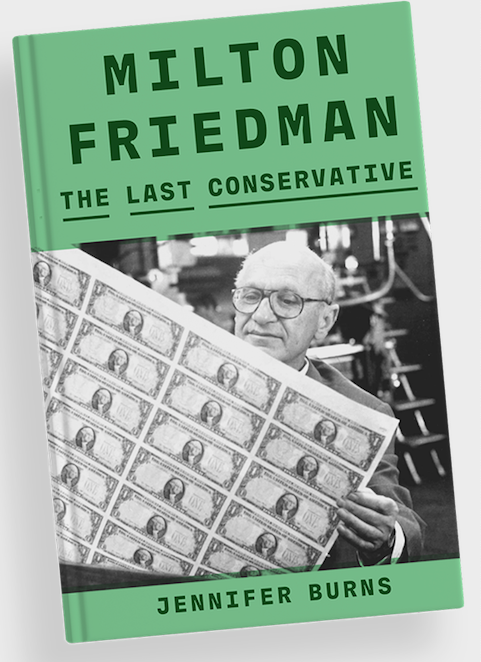
Jennifer Burns, author of a previous biography of Ayn Rand, has completed a long-anticipated biography of Milton Friedman. The Rand biography was relatively well-received among both liberals and conservatives. But I suspect that there is no biography that she could have written of Friedman that would have satisfied the different groups of readers. I think that people will both find the book useful, and also…
Many books that engage with Friedman are sharply critical. And, more broadly, the last two decades have seen a swell of popular books by left-leaning authors who excavate the history of conservative ideas and engage with them critically, from Rick Perlstein’s Before the Storm: Barry Goldwater and the Unmaking of the American Consensus to Corey Robin’s The Reactionary Mind. But Burns has opted for a different approach. In this biography, there is enough critique to mark some distance from the subject, but not so much that it would tip into hostility. Burns sees Friedman as an important innovator and an intellectual entrepreneur. If he was “the last conservative,” as her subtitle has it, it is because the American right is moving away from the core principles that he espoused and that helped to define the parameters of conservative thought and identity in the second half of the twentieth century. And if readers do not share Friedman’s way of seeing the world, Burns wants them nonetheless to understand what was appealing about his scholarship and moral philosophy, in its time and place. The book, measured by its own standards, is a success.
But there is a cost, too: Because the book avoids polemic, the reader will not leave with a deep understanding of why Friedman’s influence has faded. There are very good reasons to doubt that his view of the world is the right one for the problems of our time. Burns has written with one kind of fairness in mind. But a more critical look at Friedman’s legacy could have been fair, too. Friedman’s statue casts a long shadow, and a different vantage would have shown something less monumental, but not less true.
Read the whole review at The New Republic.

 patrick iber
Leave a comment