LACIS 260
Latin America: An Introduction
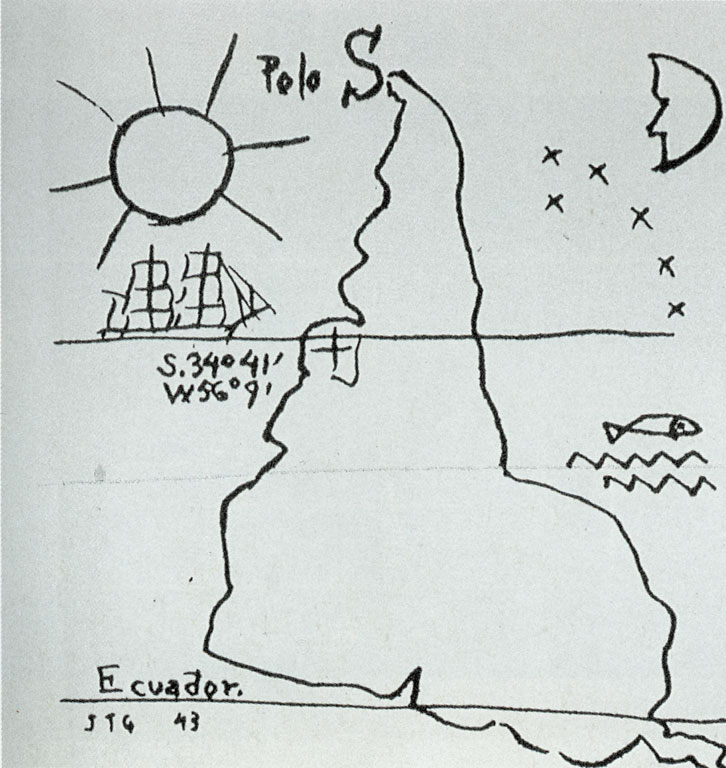
Art credit: América invertida, Joaquín Torres-García
What does politics look like under conditions of economic inequality? What sort of culture does colonialism produce? When does democracy survive, and when does it break down? When do revolutions produce real improvements for ordinary people? These all sound like questions that many have been asking in the United States in the last few years. In Latin America, they have been asked for decades.
This course will offer a broad introduction to Latin American history and culture, with a close look at those big questions. We won’t be bound by comparisons to the United States, but we will think critically and comparatively about Latin America’s experience as part of the wider world. This course is an overview, from the pre-colonial era to the present day. We are going to the explore the region in all its diversity, steering away from easy cliché or superficial analysis. The class will also be interdisciplinary in its approach: we will gather information from history, political science, economics, literature, and film. We will have guests and experts from across the university visit the class, so that if there are particular areas that interest you, you will have ideas about how you might pursue them further.
GRADING INFORMATION
Your grade will be based on the following:
20% section. Active participation in class is essential; our learning will be richest as more of you become involved in the conversation and debate. Therefore, all readings must be completed before you meet in section, and you should attend every week. You can miss one day without arranging an absence with us. Your TA will provide you with a section syllabus laying out responsibilities and expectations.
20%: Class attendance and participation. The class will use Top Hat response software to log attendance and check for understanding. Typically, a question or two will check to see if you’ve done the reading, and the next questions will start a discussion that leads into the day’s topic. Depending on the type of question, points may be given for accuracy, participation, or both.
40%: There will be three in-class exams given during the semester. One midterm worth 20% of the grade will take up a whole class block, the others, worth 10% each, will be shorter and take up less time.
20%: Final paper. The last few weeks of class will be devoted to considering the problems of Latin America today. Instead of an in-class final, there will be a final written assignment, of approximately 8 pages for most students and 15 for those taking the class for honors credit. There are two primary options for this assignment.
Option 1 is to write a “country report.” Choose a country that you wish to study in more depth, and use news sources to explain what the economic, political, and social conditions are today. You must address how these conditions are related to the country and the region’s history by making reference to class readings.
Option 2 is to read a work of literature (most likely a novel) or watch a film from Latin America. Explain the major themes of the work, and how they reflect the historical circumstances of the work’s production. As with option 1, you should refer to the ways that the work of art describes events explored during the class by referring to class readings.
The use of AI writing tools has already become pervasive. I am not going to prohibit their use, but I may ask you follow-up questions about your research to verify that it was done by a human being. You should ask yourself if you are using AI to enhance your learning, or to substitute for it. If it is the latter, you shouldn’t do it.
Thursday, Sep. 7: Introduction to the course
Chasteen, Chapter 1, “Introduction”
Questions to guide your reading this week:
What defines Latin America? What common features are there in this very diverse region?
Week 2: First Peoples of the Americas
Tuesday, Sep. 12:
Charles Mann, “1491,” The Atlantic, March 2002, http://www.theatlantic.com/magazine/archive/2002/03/1491/2445/
Nahuatl Poetry: https://mesoamericanstudiesonline.com/2022/01/30/nahuatl-poetry/
Thursday, Sep. 14:
Chasteen, Chapter 2, “Encounter”
Honors only: Bartolomé de las Casas, Short History of the Destruction of the Indies, 5-30.
Questions to consider this week:
1) What was life like for those in the major indigenous empires?
2) What do cultural products, like Nahuatl poetry, tell us about the cultures that produced them?
3) How did people on each “side” understand the encounter with new people?
4) What impact did the encounter between Europe and the Americas have on the ecology of the Americas, including its people?
Week 3: Making a Colonial Society
Tuesday, Sep. 19: Economics and Politics
Chasteen, Chapter 3, “Colonial Crucible”
Honors only: Guaman Poma, First New Chronicle and Good Government, [excerpts] https://sites.lsa.umich.edu/davidfrye/wp-content/uploads/sites/281/2015/07/guaman.pdf
Thursday, Sep. 21: Culture and Society
Karen Spalding, “The Shrinking Web,” from Huarochirí, pp. 168-208
Poetry of Sor Juana: https://www.poets.org/poetsorg/poet/sor-juana-inés-de-la-cruz
Questions to consider this week:
1) What were the purposes of Spanish and Portuguese colonialism? How did they function economically and politically?
2) What was the role of the Catholic church in these colonial systems?
3) Could you draw a diagram representing the “social pyramid” of colonial society? Who is at the top and who is at the bottom?
Week 4:
Tuesday, Sep. 26: Challenging the Colonial Order
Charles Walker and Liz Clarke, Witness to the Age of Revolution: The Odyssey of Juan Bautista Tupac Amaru, pp. 5-107
Thursday, Sep. 28: Independence
Chasteen, Chapter 4, “Independence”
Honors only: Simón Bolívar, Letter from Jamaica, https://library.brown.edu/create/modernlatinamerica/chapters/chapter-2-the-colonial-foundations/primary-documents-with-accompanying-discussion-questions/document-2-simon-bolivar-letter-from-jamaica-september-6-1815/
Questions to consider this week:
1) How did the process of Spanish American independence fit in to broader changes taking place around the globe?
2) What reasons did people have for fighting for independence? What reasons did people have for fighting against it?
Week 5: Post-independence
Tuesday, October 3: Building a New Society
Chasteen, Chapter 5, Postcolonial Blues
Thursday, October 5: The Brazilian Empire
Joaquim Nabuco anti-slavery speech, https://faculty.chass.ncsu.edu/slatta/hi216/documents/slavery/nabuco.htm
Affirmative Action reading, https://foreignpolicy.com/2017/04/05/brazils-new-problem-with-blackness-affirmative-action/
Xuxa reading, https://www.nytimes.com/2023/08/15/world/americas/brazil-barbie-xuxa.html
Quiz #1 will take place this week on Thursday, covering the material from weeks 1-4. It will include a map quiz.
Questions to consider this week:
1) How did conditions of life change as a result of independence? In what ways did they stay the same?
2) What similarities and differences do you see between the former slave societies of the United States and Brazil?
Week 6: Latin America and the World Economy
Tuesday, October 10: The Problem of Development
Chasteen, Chapter 6, Progress
Honors only: John Coatsworth, “Inequality, Institutions and Economic Growth in Latin America,” Journal of Latin American Studies 40, no. 3 (August 2008): 545-569.
Thursday, October 12: Nineteenth-Century Globalization
Chapter 7, Neocolonialism
Rubén Darío, “To Roosevelt”: https://www.poetrynook.com/poem/roosevelt [contains both English and the original Spanish]
Questions to consider this week:
1) What are reasons given to explain Latin American “underdevelopment”? What kind of evidence is used to supports those theories?
2) What is the relationship between new forms of nationalism and the neocolonialism?
Week 7: Mexico and Its Revolution
Tuesday, October 17: The Popular Revolution
Chasteen, Chapter 8, “Nationalism,” 233-265
Look at the art gallery from Castillo de Chapultepec:
https://mnh.inah.gob.mx/murales
Thursday, October 19: The Institutional Revolution
Gilbert Joseph and Jurgen Buchenau, Mexico’s Once and Future Revolution, 37-54; 117-139
Questions to consider this week:
1) Injustice is common throughout history but revolutions are rare. Why did one occur in Mexico at this time?
2) What things changed as a result of the Mexican Revolution? What did not change so much?
3) What stories do the murals at the Castillo de Chapultepec tell about the history of the Mexican nation? How do they tell the story of the Revolution?
Week 8: What is populism?
Tuesday, October 24: The Populist Strategy
Guillermoprieto, Looking for History, “Little Eva,” 3-17
Selections from Perón mediante
Jorge Luis Borges, “Pierre Menard: Author of the Quixote”, from Ficciones
Thursday, October 26: Midterm
This will be a comprehensive exam covering weeks 1-8.
Questions to guide your reading this week:
1) What is populism? How does it differ from other strategies for governing?
2) After reading the sections from Perón mediante and the story by Jorge Luis Borges, I want you to ask yourself whether Borges would have been a Perón supporter or not. Why do you think so?
Week 9: The Early Cold War
Tuesday, October 31: Guatemala
Stephen Kinzer, chapter on Guatemala from Overthrow, pp. 129-147
Look at this primary document—from the U.S. government in 1948—as it thinks about its security priorities for the region in the post-WWII period.
https://history.state.gov/historicaldocuments/frus1948v09/d161
Thursday, November 2: Cuba’s Revolution
Chasteen, Chapter 9, “Revolution,” 267-295
Honors only: Roberto Fernández Retamar, “Caliban,” [excerpts]
Questions to consider this week:
1) The Cold War was nominally a conflict between the United States and the Soviet Union. What does it mean to talk about a “Cold War” in Latin America?
2) Why did Guatemala and Cuba have different outcomes? In what ways were their movements related or informed by each other?
Week 10: Socialism(s)
Tuesday, November 7: Cuban Socialism
Deborah Shnookal, “Alfabeticemos! Let’s Teach Literacy!” from Operation Pedro Pan and the Exodus of Cuba’s Children, 63-104
Listen: audio documentary, Elizabeth Dore, “Cuban Voices,” https://www.bbc.co.uk/sounds/play/p06xfy81
Thursday, November 9: Chilean Socialism
Look at this web page and listen to the podcast on “Project Cybersyn,” https://99percentinvisible.org/episode/project-cybersyn/
Honors only: Peter Winn, “The Furies of the Andes” from A Century of Revolution, pp. 239-275
Questions to consider this week:
1) Why would people support revolutionary government? What sort of people would want them? What sort of hopes did they have for them?
2) What sort of consequences did the existence of socialist governments have in the region, including in places that did not have them?
Week 11: Reaction
Tuesday, November 14: Chile’s Dictatorship
Chasteen, Chapter 10, “Reaction,” 297-327
Thursday, November 16: Democratic Transitions
Lawrence Weschler, A Miracle, A Universe: Settling Accounts with Torturers, pp. 1-79
Honors only: Watch these videos from the 1988 plebiscite in Chile, in which Chileans voted on whether to continue the dictatorship or not. (You can turn on subtitles and auto-translate if you like.)
This was the government’s strategy to encourage the country to continue the current arrangement: https://www.youtube.com/watch?v=T7HhdbW4gHo
This was the opposition’s video: https://www.youtube.com/watch?v=bfE94ZVuJm8
Questions to consider this week:
1) What was responsible for the wave of dictatorships that took power in Latin America?
2) Beyond repression, what other strategies did dictatorships use to maintain power?
3) What sources of independent power remained, even under dictatorships? Which were limited or disappeared?
Week 12: Democratic Transitions, II
Tuesday, November 21: Mexico’s “Perfect Dictatorship”
Guillermoprieto, “Letter from Mexico City,” New Yorker, September 17, 1990
Julia Preston and Samuel Dillon, Opening Mexico, pp. 477-501
Thursday, November 23: THANKSGIVING, NO CLASS
Questions to consider this week:
1) How did Mexico’s transition to democracy differ from those of the military dictatorships of the Southern Cone?
Week 13: Latin America Today I
Tuesday, November 28: The Pink Tide
Chasteen, Chapter 11, “Neoliberalism and Beyond”
Thursday, November 30: Consequences
Jon Lee Anderson, “Slumlord,” New Yorker, 28 January 2013, pp. 40-51.
Jon Lee Anderson, “Venezuela’s Two Presidents Collide,” June 3, 2019, https://www.newyorker.com/magazine/2019/06/10/venezuelas-two-presidents-collide
The last quiz will take place this week, covering material from weeks 9-13.
Questions to consider:
1) What does “neoliberalism” mean? How was it experienced in Latin America?
2) Why did the “Pink Tide” governments emerge at the same time?
3) What were some of the political strengths and weaknesses of the “pink tide”?
Week 14: Latin America Today II
Tuesday, December 5: Security and Democracy
Guillermoprieto, Looking for History, “Our New War in Colombia,” 19-39
Fernanda Melchor, “Veracruz with a Zee for Zeta,” in This is not Miami
Thursday, December 7: Migration
Valeria Luiselli, Tell Me How it Ends, in Freeman’s (2016), pp. 141-183.
Questions to consider:
1) In the last years, the most violent places outside of war zones have been in the Americas (including in the United States). Why?
2) How are security problems and the phenomenon of migration connected? How do they affect democracy in the Americas?
Week 15: Latin America Today III
Tuesday, December 12: Roundtable of Current Issues
Readings, if any, will be light and will be determined later. Work on your final papers.
Thursday, December 14: Countercurrents: Costa Rica and Uruguay
Readings, if any, will be light and will be determined later. Work on your final papers.

 patrick iber
Leave a comment